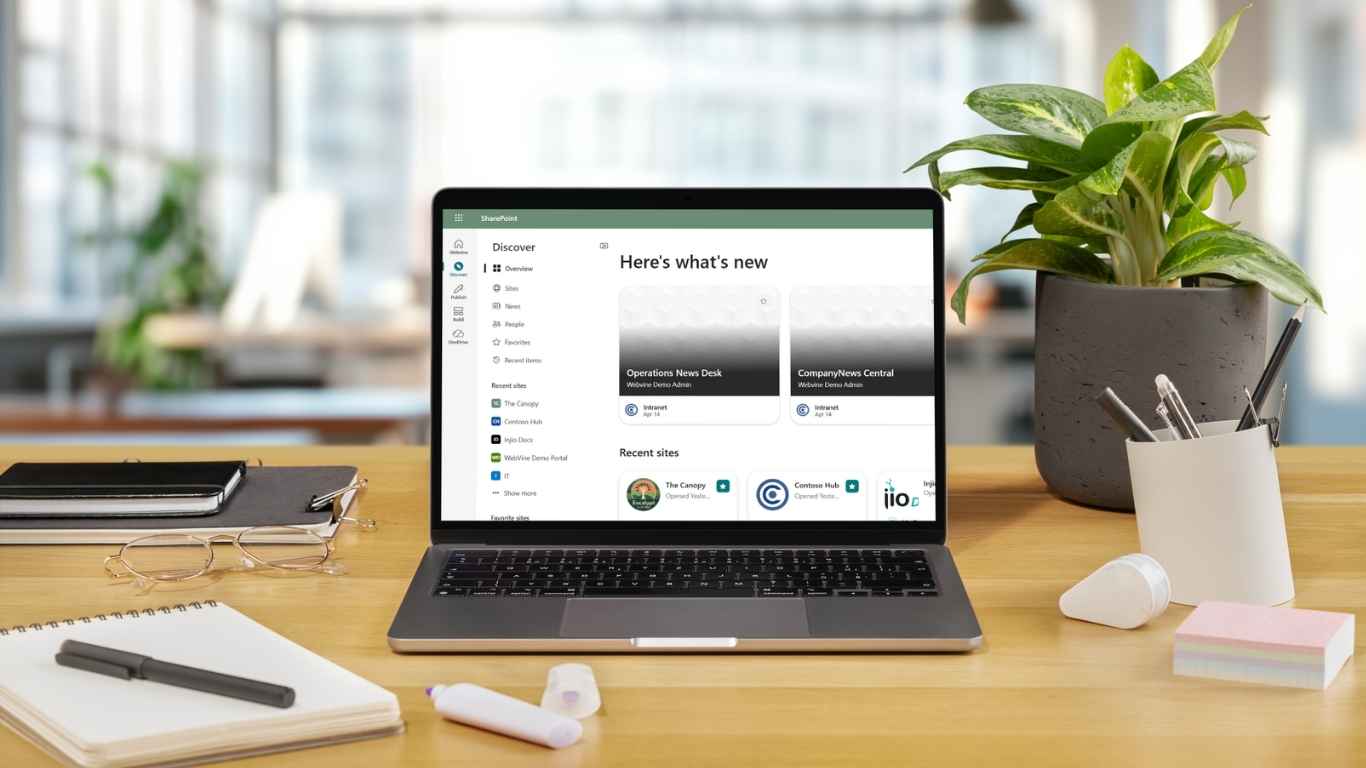
SharePoint gives organisations the tools to build an intranet. Injio extends SharePoint with governance, employee engagement, personalisation and ongoing support to help organisations maintain a trusted, effective and AI-ready digital workplace.
TL;DR
- SharePoint provides the foundation for a modern intranet, including news, search, sites and Microsoft 365 integration.
- Injio builds on SharePoint with advanced targeting, governance, employee engagement features and ongoing optimisation.
- The biggest intranet challenge is not launch, but keeping content relevant, trusted and well governed over time.
- A managed intranet (like Injio) helps organisations improve adoption, communication effectiveness and information quality long after launch.
- As Microsoft Copilot becomes more important, strong governance and accurate content become critical for better AI outcomes.
SharePoint provides the foundation for a modern intranet. It includes news publishing, communication sites, search, employee information and Microsoft 365 integration. However, many Internal Communications teams need more than publishing tools. They need targeting, governance, engagement features, ownership frameworks and ongoing optimisation to keep the intranet relevant after launch.
Managed intranet platforms like Injio are not a replacement for SharePoint. Injio is a managed digital workplace platform built on SharePoint and Microsoft 365 that combines employee engagement, trusted information management and continuous improvement.
What Is A Managed Intranet Platform?
A managed intranet platform combines intranet technology, governance tooling and ongoing support into a continuously evolving employee experience.
Unlike a traditional intranet project that ends at launch, a managed intranet includes:
- Ongoing optimisation
- Governance support
- User adoption guidance
- Product enhancements
- Information quality management
- Continuous improvement
This approach helps organisations avoid the common pattern where an intranet launches successfully but becomes outdated over time. For example, Injio was designed around a managed service model where the Injio team helps organisations continuously improve their digital workplace especially in line with advancements in technology, AI and the evolving Microsoft roadmap.
What SharePoint Already Provides
It’s true, internal communications teams can achieve a lot with SharePoint.
Out of the box, SharePoint provides:
- News publishing
- Communication Sites
- Department sites
- Search
- Document libraries
- Events
- People information
- Microsoft 365 integration
- Mobile access
- Permissions and security
- Microsoft Copilot integration through Microsoft 365 content
For many organisations, SharePoint alone can be enough.
However, many internal communications teams, the real question is not whether SharePoint can publish communications.
The question is whether it can consistently deliver the modern, personalised and continuously improving employee experience they need.
Where Internal Communications Teams Usually Need More
Based on our experience, Internal Communications teams typically encounter four challenges with their SharePoint intranet projects.
1. Engagement drops after launch
Most intranets launch successfully, but many struggle 12 months later.
Content becomes outdated. Ownership becomes unclear. Adoption stalls.
The platform exists, but continuous improvement doesn’t. And users stop using the intranet.
2. Publishing becomes difficult to manage
Communications teams often become accidental intranet administrators. Instead of focusing on strategy and employee engagement, they spend time:
- managing content
- supporting publishers
- fixing page issues
- chasing content owners
And before long, publishing content becomes deprioritised.
3. Design flexibility becomes limited
SharePoint provides excellent building blocks.
But many organisations want a more branded and engaging employee experience without commissioning custom development every time a new requirement emerges.
4. Governance is treated as a project rather than a process
Content ownership, lifecycle management and information quality are ongoing responsibilities.
Without governance, intranets gradually become harder to trust and harder to maintain. This affects the trust placed in the content on the intranet.
AI tools like Copilot also rely on content on the intranet when generating answers. If the content on the intranet is outdated, this impacts the information AI tools share.
SharePoint vs Injio for Internal Communications
There are some key differences between using SharePoint and a managed intranet platform for internal communications teams:
| Capability | SharePoint Out-of-the-Box | Injio (A managed intranet platform) |
| Corporate news publishing | ✓ | ✓ |
| Department communications | ✓ | ✓ |
| Search | ✓ | ✓ |
| Staff directory | ✓ | ✓ |
| Events | ✓ | ✓ |
| Mobile access | ✓ | ✓ |
| Microsoft 365 integration | Native | Native |
| Personalised experiences | Configuration dependent | Advanced targeting |
| Audience-based communications | Basic | Enhanced |
| Employee engagement modules | Limited | Included platforms and modules |
| Recognition and culture experiences | Configuration required | Built-in capabilities |
| Flexible homepage experiences | Standard web parts | Expanded design framework |
| Governance tooling | Manual processes | Governance-focused administration tools |
| Content ownership framework | Organisation defined | Supported through governance model |
| Lifecycle management | Manual | Enhanced administration capabilities |
| Ongoing optimisation | Internal responsibility | Managed service |
| Continuous product enhancements | Internal roadmap | Product roadmap and customer success model |
| Microsoft 365 adoption support | Internal responsibility | Included as part of managed engagement by the Injio team |
The important thing to understand is that Injio is not replacing SharePoint.
It is extending SharePoint with advanced intranet capability, intelligent administration tools and ongoing expert support.
Intranet Homepage Anatomy: SharePoint vs Injio
A Typical SharePoint Homepage
Usually contains:
- News
- Quick links
- Events
- Search
- Department sites
- Employee resources
A Typical Injio Homepage
In addition to SharePoint foundations, on their intranet homepage organisations commonly include:
- Controlled urgent communications
- Dedicated peer recognition and participation tools
- Personalised, employee managed shortcuts
- A scrollable new ticker with configurable options
- Polls and Submit Ideas options
- Personalised lists for specific employees (like starters, leavers, personal groups), which reduces manual homepage maintenance
- Searchable staff directory on the homepage
- scheduled alerts or announcements
- scheduled employee spotlights
- Events calendars which support recurring and one off events and category colours and adding events to Outlook
- Richer engagement on galleries and images
- Image carousel with social engagement features
Platform Versus Operating Model: The Difference Most Intranet Projects Miss
We find most SharePoint discussions focus on platform features.
However, from our experience, successful intranets are usually determined by something else:
Who owns the experience after launch?
Many intranets launch successfully, but 12 months later:
- content is outdated
- governance is inconsistent
- adoption has plateaued
- ownership is unclear
The platform is still there. The operating model is missing. SharePoint provides technology. But the governance layer is missing.
The support provided by a managed intranet adds
- governance frameworks
- content ownership models
- optimisation programs
- adoption support
- platform enhancements
- expert guidance
- continuous improvement
Managed intranet platforms like Injio are designed around the idea that a digital workplace should evolve over time rather than remain static after launch.
Why This Matters More in the Age of Copilot
Microsoft Copilot can only work with the information available to it.
If content is outdated, poorly governed, hard to find and missing ownership, employees and AI systems face the same challenge.
A successful intranet is no longer just a communication channel. It is increasingly part of an organisation’s knowledge and AI foundation.
Which Option Fits Which Organisation?
SharePoint May Be Enough If:
- You have strong internal SharePoint capability
- Your requirements are relatively simple
- Your team can manage governance internally
- You have dedicated intranet resources
Injio May Be A Better Fit If:
- You need to push design and capabilities further than generic SharePoint
- Employee engagement is a key measure of success
- You need targeted communication experiences
- Governance has become difficult to maintain with sprawling content
- You want to improve Microsoft 365 adoption
- You want a platform that continuously evolves
- You prefer a managed model instead of a custom build
Organisations that see their intranet as a strategic communication channel often benefit most from a managed platform approach because success depends on both technology and ongoing execution.
The choice is rarely SharePoint or Injio.
SharePoint remains the foundation. The real decision is whether SharePoint alone provides enough capability, governance and ongoing support to achieve your communication and employee experience goals.
For some organisations, it does.
For others, a managed intranet platform provides the targeting, engagement, governance and continuous improvement needed to turn SharePoint into a digital workplace employees genuinely rely on.
As Microsoft’s capabilities continue to evolve and AI becomes increasingly dependent on trusted content, organisations should think beyond launch and consider how their intranet will improve over the next three to five years, not just the next three months.
See the Comparison in Your Own Context
We’ve seen that every organisation’s requirements are different.
Some teams can achieve their goals with SharePoint alone.
Others benefit from stronger governance, targeting, employee engagement and continuous improvement capabilities.
If you’re still questioning whether a managed intranet platform is the right solution for you, book a personalised Injio demonstration and we’ll compare your current SharePoint environment against your internal communications goals.
About the Author – Chloe Dervin
Chloe Dervin is the Managing Director of WebVine, the team behind Injio. She has spent more than 15 years helping organisations design, implement and optimise SharePoint-based digital workplaces, intranets and Microsoft 365 solutions. Working closely with clients and the WebVine team every day, Chloe advises organisations on intranet strategy, governance, employee engagement, information management and Microsoft 365 adoption. Her practical experience helping organisations build modern, sustainable digital workplaces provides the insights shared throughout this article.
FAQs
Can SharePoint be used as an intranet?
Yes. SharePoint includes communication sites, news publishing, search, document management and Microsoft 365 integration, making it a common intranet foundation.
What is a managed intranet platform?
A managed intranet platform combines intranet technology, governance, optimisation and ongoing support to help organisations continuously improve the employee experience.
Does Injio replace SharePoint?
No. Injio runs within Microsoft 365 and SharePoint. It extends SharePoint with employee experience, governance and managed service capabilities.
Why do organisations build an intranet on SharePoint?
Because SharePoint is already included in many Microsoft 365 environments and provides strong publishing, collaboration and information management capabilities.
What are the limitations of SharePoint for Internal Communications?
The most common challenges involve governance, content ownership, employee engagement, personalisation and ongoing optimisation rather than publishing capability itself.
Who is WebVine?
WebVine is the team behind Injio and is a Microsoft Solutions and Specialization partner. The WebVine team has more than 15 years of experience in SharePoint and Microsoft solutions and built Injio to combine powerful employee experiences, trusted information management and ongoing innovation in one managed platform. The WebVine team continually improves Injio and works with our clients to ensure it delivers value long after launch.